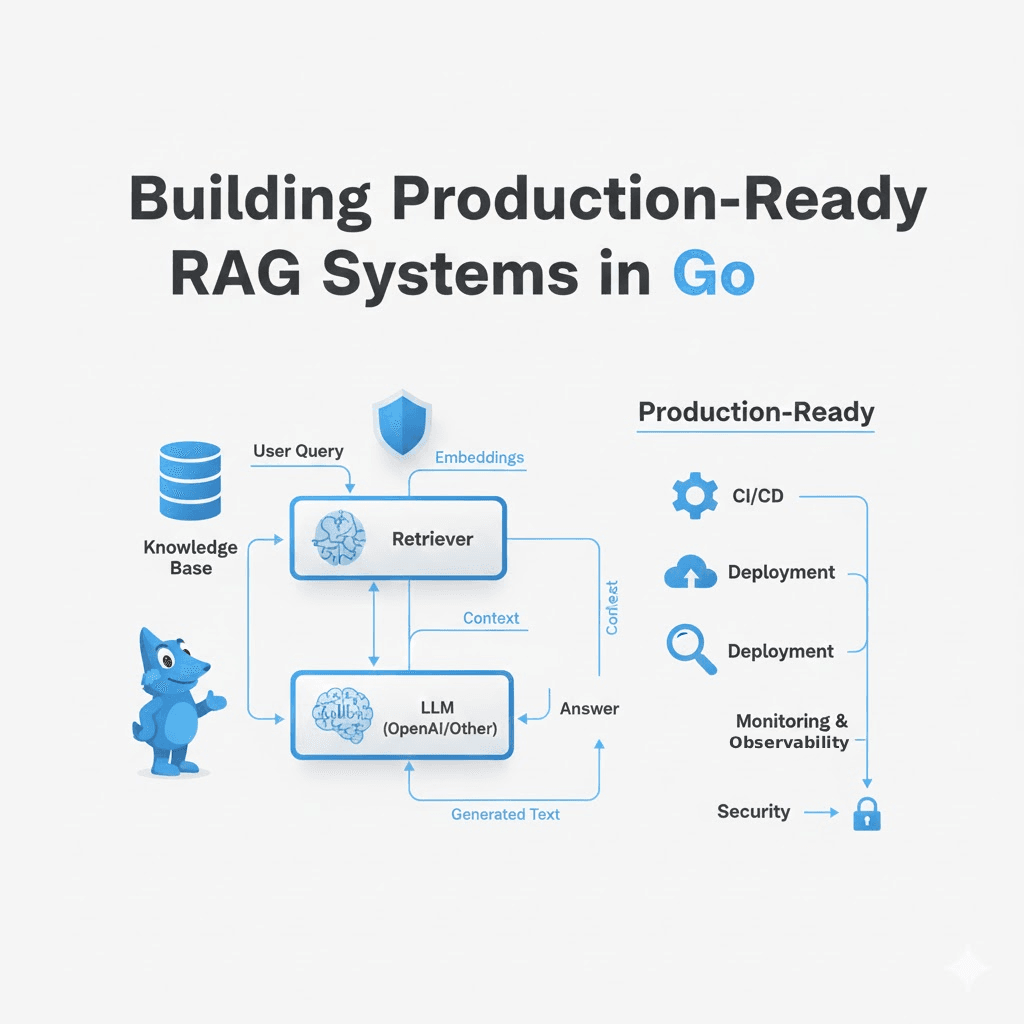
Building Production-Ready RAG Systems in Go
Retrieval-Augmented Generation (RAG) has become the go-to architecture for building AI applications that need to access external knowledge. While Python dominates the AI tooling landscape, Go offers compelling advantages for production RAG systems: superior performance, built-in concurrency, small memory footprint, and excellent deployment characteristics.
In this guide, we'll explore how to build a production-ready RAG system in Go, covering everything from core data structures to deployment considerations.
Why Go for RAG?
Before diving into implementation, let's understand why Go makes sense for RAG systems:
- Performance: Go's compiled nature and efficient garbage collector handle high-throughput vector operations better than interpreted languages
- Concurrency: Native goroutines make parallel document processing and batch embedding generation straightforward
- Deployment: Single binary deployment with no runtime dependencies simplifies operations
- Resource efficiency: Lower memory footprint means better cost efficiency at scale
- Type safety: Strong typing catches errors at compile time, crucial for production systems
Core Architecture
A production RAG system consists of several key components:
User Query → Query Processing → Vector Search → Context Ranking → LLM Generation → Response ↓ ↓ Document Pipeline Vector Database Essential Data Structures
Let's start with the foundational data structures for our RAG system:
package rag import ( \"context\" \"time\" ) // Document represents a source document in the RAG system type Document struct { ID string json:\"id\" Content string json:\"content\" Metadata map[string]any json:\"metadata\" Source string json:\"source\" CreatedAt time.Time json:\"created_at\" UpdatedAt time.Time json:\"updated_at\" } // Chunk represents a processed chunk of a document type Chunk struct { ID string json:\"id\" DocumentID string json:\"document_id\" Content string json:\"content\" Embedding []float32 json:\"embedding,omitempty\" Position int json:\"position\" Metadata map[string]any json:\"metadata\" TokenCount int json:\"token_count\" } // SearchResult represents a retrieved chunk with relevance score type SearchResult struct { Chunk *Chunk json:\"chunk\" Score float32 json:\"score\" Rank int json:\"rank\" } // RAGRequest encapsulates a user query type RAGRequest struct { Query string json:\"query\" TopK int json:\"top_k\" Filters map[string]any json:\"filters,omitempty\" Context context.Context json:\"-\" } // RAGResponse contains the generated response and sources type RAGResponse struct { Answer string json:\"answer\" Sources []SearchResult json:\"sources\" Latency time.Duration json:\"latency\" TokensUsed int json:\"tokens_used\" } Document Processing Pipeline
The ingestion pipeline is critical for RAG quality. Here's a robust implementation:
// DocumentProcessor handles document ingestion and chunking type DocumentProcessor struct { chunkSize int chunkOverlap int embedder Embedder vectorStore VectorStore } func NewDocumentProcessor(chunkSize, overlap int, embedder Embedder, store VectorStore) *DocumentProcessor { return &DocumentProcessor{ chunkSize: chunkSize, chunkOverlap: overlap, embedder: embedder, vectorStore: store, } } // ProcessDocument handles the complete document processing pipeline func (dp *DocumentProcessor) ProcessDocument(ctx context.Context, doc *Document) error { // 1. Chunk the document chunks := dp.chunkDocument(doc) // 2. Generate embeddings in parallel if err := dp.generateEmbeddings(ctx, chunks); err != nil { return fmt.Errorf(\"embedding generation failed: %w\", err) } // 3. Store in vector database if err := dp.vectorStore.UpsertChunks(ctx, chunks); err != nil { return fmt.Errorf(\"vector store upsert failed: %w\", err) } return nil } // chunkDocument splits a document into overlapping chunks func (dp *DocumentProcessor) chunkDocument(doc *Document) []*Chunk { content := doc.Content chunks := make([]*Chunk, 0) position := 0 for i := 0; i < len(content); i += (dp.chunkSize - dp.chunkOverlap) { end := i + dp.chunkSize if end > len(content) { end = len(content) } chunk := &Chunk{ ID: fmt.Sprintf(\"%s_chunk_%d\", doc.ID, position), DocumentID: doc.ID, Content: content[i:end], Position: position, Metadata: doc.Metadata, } chunks = append(chunks, chunk) position++ if end >= len(content) { break } } return chunks } // generateEmbeddings creates embeddings for chunks in parallel func (dp *DocumentProcessor) generateEmbeddings(ctx context.Context, chunks []*Chunk) error { const batchSize = 10 errChan := make(chan error, len(chunks)) semaphore := make(chan struct{}, batchSize) var wg sync.WaitGroup for _, chunk := range chunks { wg.Add(1) go func(c *Chunk) { defer wg.Done() semaphore <- struct{}{} defer func() { <-semaphore }() embedding, err := dp.embedder.Embed(ctx, c.Content) if err != nil { errChan <- err return } c.Embedding = embedding }(chunk) } wg.Wait() close(errChan) if err := <-errChan; err != nil { return err } return nil } Vector Search Interface
Define clean interfaces for vector storage and retrieval:
// VectorStore defines the interface for vector database operations type VectorStore interface { UpsertChunks(ctx context.Context, chunks []*Chunk) error Search(ctx context.Context, query []float32, topK int, filters map[string]any) ([]SearchResult, error) Delete(ctx context.Context, documentID string) error HealthCheck(ctx context.Context) error } // Embedder defines the interface for generating embeddings type Embedder interface { Embed(ctx context.Context, text string) ([]float32, error) EmbedBatch(ctx context.Context, texts []string) ([][]float32, error) Dimensions() int } RAG Orchestrator
The orchestrator ties everything together:
// RAGSystem orchestrates the complete RAG pipeline type RAGSystem struct { embedder Embedder vectorStore VectorStore llmClient LLMClient processor *DocumentProcessor } func NewRAGSystem(embedder Embedder, store VectorStore, llm LLMClient) *RAGSystem { return &RAGSystem{ embedder: embedder, vectorStore: store, llmClient: llm, processor: NewDocumentProcessor(512, 50, embedder, store), } } // Query processes a RAG query end-to-end func (rs *RAGSystem) Query(ctx context.Context, req *RAGRequest) (*RAGResponse, error) { start := time.Now() // 1. Embed the query queryEmbedding, err := rs.embedder.Embed(ctx, req.Query) if err != nil { return nil, fmt.Errorf(\"query embedding failed: %w\", err) } // 2. Search vector store results, err := rs.vectorStore.Search(ctx, queryEmbedding, req.TopK, req.Filters) if err != nil { return nil, fmt.Errorf(\"vector search failed: %w\", err) } // 3. Build context from results context := rs.buildContext(results) // 4. Generate response with LLM answer, tokens, err := rs.llmClient.Generate(ctx, req.Query, context) if err != nil { return nil, fmt.Errorf(\"LLM generation failed: %w\", err) } return &RAGResponse{ Answer: answer, Sources: results, Latency: time.Since(start), TokensUsed: tokens, }, nil } // buildContext constructs the context string from search results func (rs *RAGSystem) buildContext(results []SearchResult) string { var builder strings.Builder builder.WriteString(\"Use the following context to answer the question:\\n\\n\") for i, result := range results { builder.WriteString(fmt.Sprintf(\"Source %d (relevance: %.2f):\\n\", i+1, result.Score)) builder.WriteString(result.Chunk.Content) builder.WriteString(\"\\n\\n\") } return builder.String() } Production Considerations
1. Error Handling and Retries
type RetryConfig struct { MaxAttempts int InitialDelay time.Duration MaxDelay time.Duration Multiplier float64 } func withRetry(ctx context.Context, cfg RetryConfig, fn func() error) error { delay := cfg.InitialDelay for attempt := 0; attempt < cfg.MaxAttempts; attempt++ { if err := fn(); err == nil { return nil } else if !isRetryable(err) { return err } select { case <-ctx.Done(): return ctx.Err() case <-time.After(delay): delay = time.Duration(float64(delay) * cfg.Multiplier) if delay > cfg.MaxDelay { delay = cfg.MaxDelay } } } return fmt.Errorf(\"max retry attempts exceeded\") } 2. Monitoring and Observability
type Metrics struct { QueryLatency prometheus.Histogram EmbeddingLatency prometheus.Histogram SearchLatency prometheus.Histogram LLMLatency prometheus.Histogram ErrorCount prometheus.Counter RequestCount prometheus.Counter } func (rs *RAGSystem) QueryWithMetrics(ctx context.Context, req *RAGRequest) (*RAGResponse, error) { rs.metrics.RequestCount.Inc() start := time.Now() response, err := rs.Query(ctx, req) if err != nil { rs.metrics.ErrorCount.Inc() return nil, err } rs.metrics.QueryLatency.Observe(time.Since(start).Seconds()) return response, nil } 3. Caching Layer
type CachedRAGSystem struct { *RAGSystem cache Cache ttl time.Duration } func (crs *CachedRAGSystem) Query(ctx context.Context, req *RAGRequest) (*RAGResponse, error) { cacheKey := fmt.Sprintf(\"rag:%s\", hashQuery(req)) // Check cache if cached, found := crs.cache.Get(cacheKey); found { return cached.(*RAGResponse), nil } // Execute query response, err := crs.RAGSystem.Query(ctx, req) if err != nil { return nil, err } // Cache result crs.cache.Set(cacheKey, response, crs.ttl) return response, nil } Testing Strategy
func TestRAGSystem(t *testing.T) { // Use test doubles mockEmbedder := &MockEmbedder{} mockStore := &MockVectorStore{} mockLLM := &MockLLMClient{} system := NewRAGSystem(mockEmbedder, mockStore, mockLLM) t.Run(\"successful query\", func(t *testing.T) { ctx := context.Background() req := &RAGRequest{ Query: \"What is RAG?\", TopK: 5, } mockEmbedder.On(\"Embed\", ctx, req.Query).Return([]float32{0.1, 0.2}, nil) mockStore.On(\"Search\", ctx, mock.Anything, 5, mock.Anything).Return([]SearchResult{}, nil) mockLLM.On(\"Generate\", ctx, mock.Anything, mock.Anything).Return(\"RAG is...\", 100, nil) response, err := system.Query(ctx, req) assert.NoError(t, err) assert.NotNil(t, response) assert.Greater(t, response.TokensUsed, 0) }) } Deployment Architecture
For production deployment, consider this architecture:
┌─────────────┐ │ Load │ │ Balancer │ └──────┬──────┘ │ ┌───┴────┐ │ API │ ← Go RAG Service (multiple instances) │ Gateway│ └───┬────┘ │ ┌───┴─────────────────┐ │ │ ┌──▼───────┐ ┌─────▼──────┐ │ Vector │ │ LLM │ │ DB │ │ Service │ │(Pinecone/│ │ (OpenAI) │ │ Weaviate)│ └────────────┘ └──────────┘ Performance Optimization Tips
- Batch embedding generation: Process multiple documents in parallel
- Connection pooling: Reuse HTTP connections to external services
- Async processing: Use background workers for document ingestion
- Index optimization: Tune vector database index parameters for your workload
- Context window management: Implement smart context truncation for large result sets
Conclusion
Building production-ready RAG systems in Go offers significant advantages in performance, reliability, and operational simplicity. The combination of strong typing, excellent concurrency primitives, and efficient resource utilization makes Go an excellent choice for RAG deployments at scale.
The data structures and patterns outlined here provide a solid foundation for building robust RAG systems. Remember to focus on observability, error handling, and testing to ensure your system performs reliably in production.
Next Steps
- Implement hybrid search (combining dense and sparse retrieval)
- Add re-ranking models for improved relevance
- Explore query expansion techniques
- Implement user feedback loops for continuous improvement
- Add support for multimodal RAG (text + images)
Happy building!